
Keep everyone clear
Close off the area from a safe position and use 999 or 105 when the danger involves life, a road or electricity lines.

Emergency and storm work
Call our 24-hour emergency tree service when a failed tree or branch puts people, buildings or access at risk. Keep clear and tell us the address, what has failed and what is blocked.
What this service covers
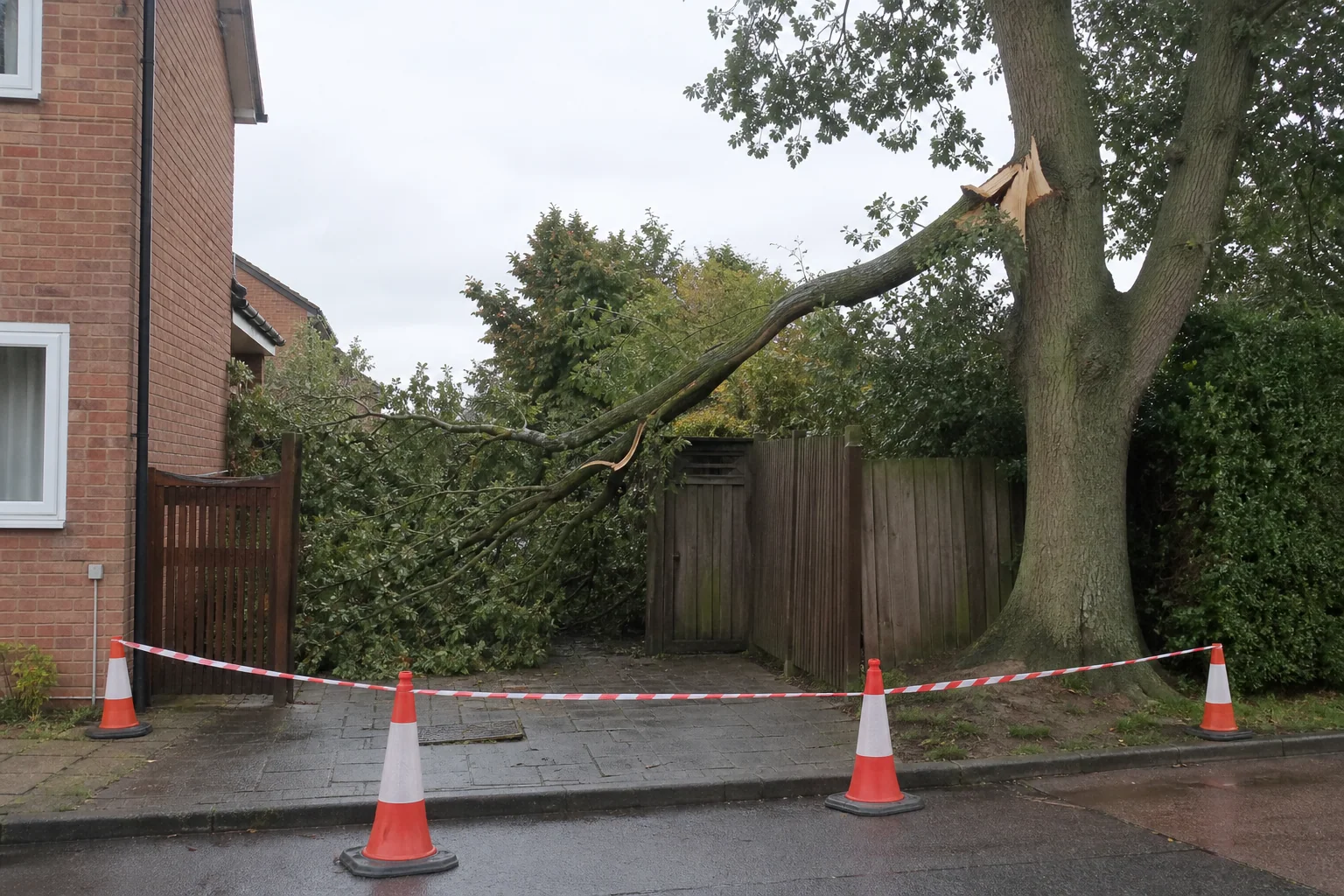
A split limb, hung-up branch or partly uprooted tree can move after the wind has eased. Keep people, pets and vehicles away. Do not stand beneath it, climb the tree, pull at branches or try to cut material under tension. Close a gate or use a safe route around the area if you can do so without going near the tree. Forestry Commission guidance warns that windblown and snapped trees are more hazardous to work on than normal felling.
Call 999 when there is an immediate danger to life, a serious collision risk or another emergency that needs the emergency services. If a tree or branch has affected electricity lines, stay well away and call 105 for the local network operator. Electricity can jump a gap, and a tree touching a line may conduct it. Do not touch the tree, a fence or anything else that may be in contact with the line.
Tell us what has happened, where the tree is and what sits within reach of the damaged part. Photos taken from a safe position can show the whole tree, the failed limb, nearby buildings and the access from the road. They do not prove that the tree is safe, and we will not diagnose a damaged tree from photographs alone.
Do not enter the danger area to take photographs.
How it works
Close off the area from a safe position and use 999 or 105 when the danger involves life, a road or electricity lines.
Give the address, what has failed, what is within reach and the access available from the road.
We confirm the controlled area, the immediate task and what can safely be completed in the conditions.
Our emergency call-out covers storm-damaged and unsafe trees across Iver, Slough and the Buckinghamshire service area. That can include a branch over an entrance, a failed section beside a building or a tree that has fallen across private access. The first aim is to understand the immediate risk and the room available to work. We do not offer tree surveys or consultancy reports.
A call at night does not mean the tree can always be worked on safely at once. Wind, visibility, road conditions, access and the position of the damaged wood all affect what can be done. We confirm the practical next step from the information available. We do not advertise an arrival or response-time guarantee.
Appropriately assigned members of our qualified team carry out the agreed tree work. We carry £10 million public liability insurance. Those facts matter on an urgent job, but they do not replace a clear working area and a method suited to the actual damage.
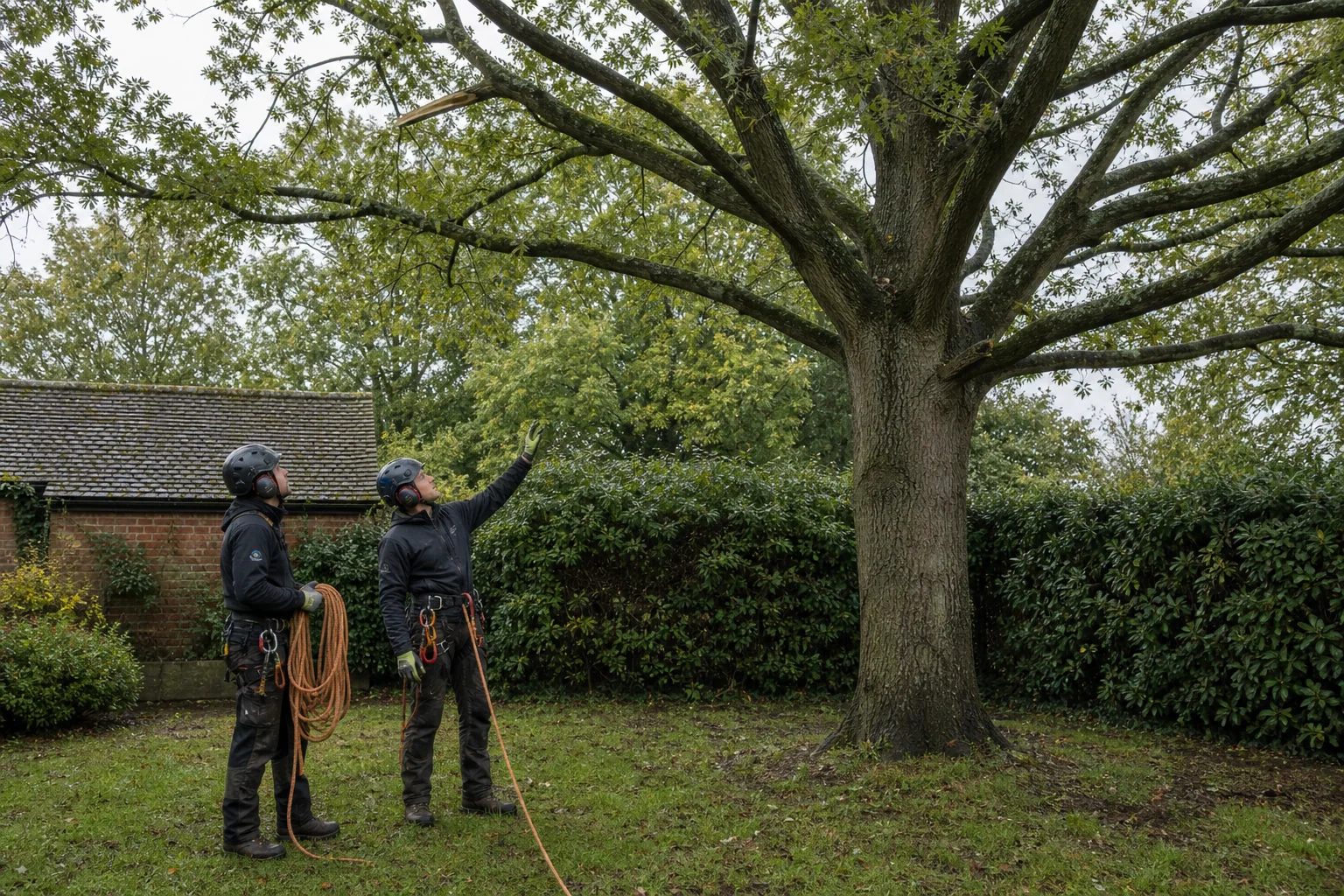
Before cutting starts, we set the working zone around the failed part and check the ground, access and anything below the crown. Storm damage can leave timber twisted, compressed or held by another branch. The cutting and rope plan must account for where each piece could move when that tension is released. Work stops if somebody enters the controlled area.
The immediate task may be to remove one broken limb, lower a damaged section or make a fallen tree safe enough to reopen agreed access. A tree does not automatically need complete removal because one branch has failed. Equally, cutting off the obvious hanging piece may not be the whole answer. The extent of emergency work is agreed from what can be established safely on site.
Clean-up is included in every job. What happens to branches, chip and timber is agreed for that call-out, because access and conditions can limit what is practical during the urgent phase. Any further non-urgent work can be described and priced separately once the immediate risk has been dealt with.
A Tree Preservation Order or conservation-area control does not always prevent urgent safety work. GOV.UK guidance allows an exception where a tree or branch presents an immediate risk of serious harm and work is urgently needed. The work should go no further than needed to remove that risk, and written notice must be given to the local planning authority as soon as practicable after the work becomes necessary. A damaged tree that is not an immediate serious risk follows the normal permission route.
Keep photographs and a note of what failed before work, but only take them from a safe place. They can help record why urgent action was needed. The landowner remains responsible for the protected-tree position and any replacement duty that follows. If there is time to contact the local planning authority safely, do so.
Wildlife law still applies during emergency tree work. Active wild-bird nests are protected, and bats and their roosts have strict legal protection. If protected wildlife is found or suspected, the work plan may need to change and advice may be needed from Natural England. Safety work and wildlife protection have to be considered together, even after a storm.
Straight answers
A recent failure that creates an immediate risk to people, property, a road or essential access may need emergency work. Keep clear and call 999 if life is at immediate risk. We do not confirm a tree's safety from a photo.
Yes. Woodside offers a 24-hour emergency call-out. We do not promise a fixed response time because wind, visibility, access and other active call-outs affect what can be done safely.
There is a narrow exception for work urgently needed to remove an immediate risk of serious harm. Only the necessary work is covered, evidence should be kept and the local planning authority must be notified as soon as practicable. Non-urgent work follows the normal permission route.